- Categories:
Context functions (Session Object)
INVOKER_
Returns the name of the account-level role of the object executing the query or NULL if the name of the role is a database role.
Syntax
Arguments
None.
Usage notes
-
If using the INVOKER_ROLE function with masking policy, verify that your Snowflake account is Enterprise Edition or higher.
-
The following table summarizes the relationship between the query context and the role the function evaluates.
Context Evaluated role User CURRENT_ROLE Table CURRENT_ROLE. View View owner role. UDF UDF owner role. Stored procedure with caller’s right CURRENT_ROLE. Stored procedure with owner’s right Stored procedure owner role. Task Task owner role. Stream The role that queries a given stream. -
The following diagram shows the relationship of a query performer, roles in Snowflake, and masking policies on tables or views.
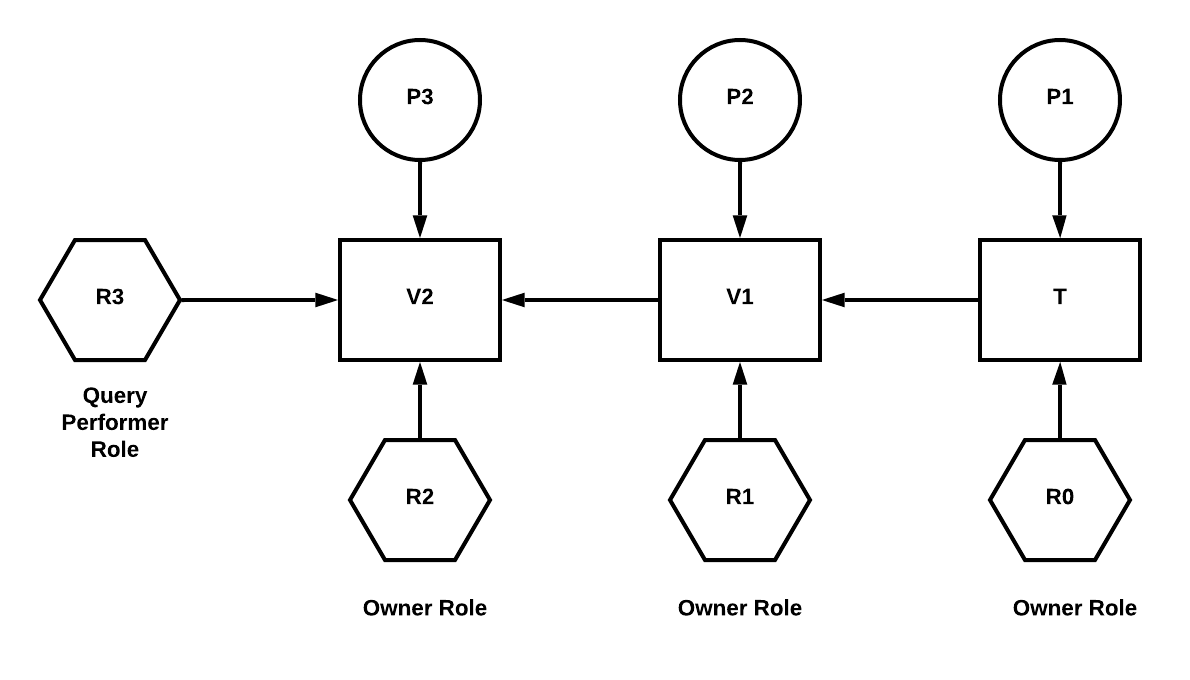
Where:
-
R0, R1, R2, R3Are roles in Snowflake.
-
P1, P2, P3Are masking policies in Snowflake.
-
V1, V2Are views in Snowflake.
-
TIs a table in Snowflake.
Based on this diagram, the values of CURRENT_ROLE and INVOKER_ROLE in a query are as follows:
Policy CURRENT_ROLE INVOKER_ROLE P1 R3 R1 P2 R3 R2 P3 R3 R3 -
Examples
The following examples show how to use the INVOKER_ROLE in a masking policy SQL expression.
Return NULL for unauthorized users:
Return a static masked value for unauthorized users:
Return a hash value using SHA2 , SHA2_HEX for unauthorized users: